Pages

Showing posts with label Analysis. Show all posts

Saturday, April 30, 2016

[BoRT: April] ill digestions

THE WORLD EATS BODIES


The world eats bodies,
And everything eaten in the world dies.
Truth eats life,
But no one fed on truth will find death.
Jesus came and he carried food,
Giving life to whoever wanted it
So they might not die.


-Barnstone & Meyer, The Gnostic Bible, Shambhala Publications Inc. Boston. 2003. 284


So if we are to make an examination of food in games during this month’s Blog of the Round Table then I feel a certain emphasis must be placed on games that layer together the complexities of consuming and how the metrics of meals can be tangled and re-tangled within a single ludic system. Call it calories or energy, hyper potions or Lon Lon Milk; game design has the potential to call upon the long tradition of using food as a symbol that weaves together concepts of existence, morality, fertility, and divinity in stories of grand feasts or humble last suppers. The trading card game, Magic: The Gathering, characterizes the potential nuances of games as multi-layered acts of feeding. Like the gnostic passage above, the resources with the game both synergize and antagonize each other until we realize that quite everything is edible.


The Menu


Magic is known for releasing new cards every few months in sets known as ‘blocks’ in which the designers at Wizards of the Coast put emphasis on particular aspects of the core, “vanilla,” gameplay. At its most basic, a game of Magic consists of a deck of hand-selected cards, known as a ‘library,’ as well as a discard pile for cast spells and dead creatures known as the ‘graveyard.’ Players play land cards that can then be used to pay the casting costs of spells and creatures. They deal damage back and forth until one can reduce the other’s life total from twenty to zero. The alternative win condition states that a player loses if they can no longer draw a card at the beginning of their deck (i.e. their deck has been completely discarded into their graveyard). These two long-standing win conditions create a simple binary between the player’s physical fitness (life total) and mental fitness (a full library).


The immediate link between these two measurements of health is the overtly demonic mechanic of sacrificing life to draw additional cards or perform other actions that might ultimately pay-off by killing the opponent faster than you can destroy yourself. In fact, much of the morality built into Magic’s five-sided “color wheel” relates to the ways that each color of spell consumes or renews life total and card availability. Black spells traditionally exhibit a certain greed and aesthetic of the disposable while white and green value protection and longevity. Red and Blue provide a spectrum respectively between chaos and control of these same resources.
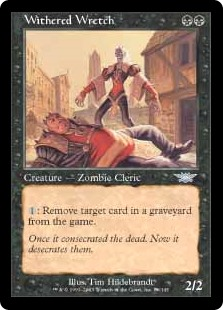

An example of a pre-exile card that transports cards out of the graveyard. The irony of a zombie-cleric making the sacred profane might point to how we interpret these game spaces.

Later in the 2010 rule update, Magic added an additional play area known as ‘the exile zone’ to solidify a space which several cards had already begun to experiment with the card text: ‘remove from the game.’ The concept of exile was to push for a space that was even harder to access than the graveyard. Whereas some spells could be cast out of the graveyard and other spells specialized in reviving your beloved creatures, the exile zone remains almost all-but-impenetrable. Between this trinity of zones, the five colors fight for unattainable supremacy in a never ending cycle.

Savory Combinations
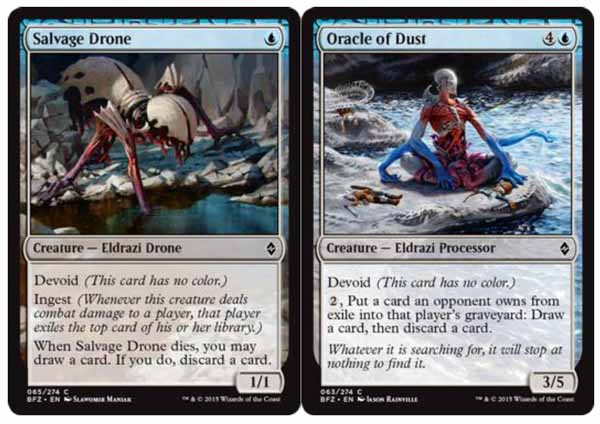

One potential combination of the ingest-process combo shared between to Eldrazi

The two most recent blocks devilishly push and pull between the meanings and implications of these three spaces. Starting with the Eldrazi monsters of the Battle for Zendikar block, Magic developed a mechanic known as ‘Ingest’ that would allow Eldrazi to “eat” through a player’s library and exile the lost cards. In addition, other Eldrazi have the ability to ‘Process’ exiled cards and return them back to the graveyard as payment for special creature abilities. There’s a certain scientific (perhaps hydroelectric) feel to an ex nihilo mechanic which diverts a card’s potential energy through the exile zone before returning it to play and harnessing it against an opponent. Playing an Eldrazi deck forces a opponent to pay attention not just to what’s on the board and what’s in their hand but also how much of their deck has been removed from game. Thus while earlier cards such as Withered Wretch wished to simplify the game by exiling a card, the Eldrazi feed the exile space in order to confuse what is meta- or “beyond” the game and what is still very much a part of the game-as-metagame.

In response to the corporeal experience of fighting Eldrazi, the following block: Shadows Over Innistrad, completely reverses the nihilism and builds on the Gothic theme that nothing ever dies. Spirits, vampires, and nightmarish horrors linger in this set and often return to play or revive themselves. The two-faced card “Startled Awake” and “Persistent Nightmare,” visible below, plays with the notion of mental trauma as the card’s abilities allow it to physically cycle from hand to graveyard to play and back again to feed on the other player’s deck.
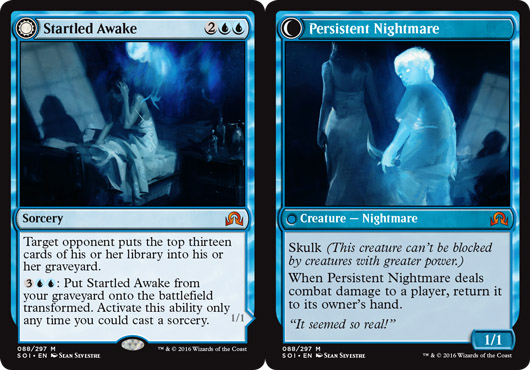

Depletion of sleep and card advantage

Mental Meals

Despite the threat of reducing one’s library to zero present in cards such as “Startled Awake,” Shadows Over Innistrad pays equal attention to the player’s own graveyard. The mechanics known as ‘Madness’ and ‘Delirium’ twist the concept of a full library as mental stability while also transmuting the notion of a graveyard into a strange receptacle of both mental and physical corpses. Cards with ‘Madness’ state: “If you discard this card, discard it into exile, When you do, you may cast it for its madness cost or put it into your graveyard.” The parallels to ‘Ingest’ ought to be clear but this time, instead of an opponent abusing the library to feed their ravenous creatures, the player willingly sends their own cards into exile only to reconstitute them back into play. The mechanic’s name draws upon the 19th century conception of madness (see the works of Charlotte Perkins Gilman or Nikolai Gogol) as a professed assertion of a different reality. The traditional heuristics of Magic suggest that discarding a card from your hand hurts your potential to play that card later on in the game. ‘Madness’ rewrites that assumption and allows you to engage in your own self-destruction and profit in return. 

A card such as “Alms of Vein” perfectly elides the theme of vampiric loss and renewal that repeats throughout the cards. While vampires are traditionally thought to be predatory, the card’s image suggest the first-person viewpoint of a character who charitably gives to the vampire repeatedly in order to receive some sort of reward. The image further confuses the relationship between player and opponent: is the player mad to allow a vampire to take their own blood in payment for blood magic, or does the spell suggest that the player is the vampire leeching the life away from the opponent? ‘Madness’ pressures the player to use every card, to actively remove your hand while simultaneously stretching the potential energy of that movement.
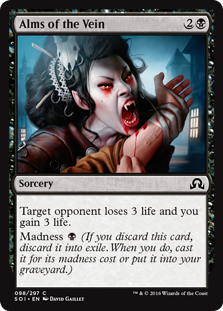

Card art as complex representation of food and loss


After all this self-sacrifice settles the set's second key graveyard mechanic begins to take hold. Cards with ‘Delirium’ have a trigger that activates further abilities if the player has four or more card types in your graveyard. The mechanic puts pressure on getting not just sorceries and instants (spells that naturally resolve and go to your graveyard) but also creatures, lands, enchantments, and artifacts buried into the dirt. An initial interpretation of ‘Delirium’ suggests that the mechanic invokes some sort of hallucination or confusion within the mind. While other decks (think of someone playing against the Eldrazi’s ‘Ingest’) might consider spells sent to the graveyard as lost potential, a deck specializing in ‘Delirium’ prefers to actively diversify their portfolio of lost cards. The graveyard is no longer the antithesis of the library but a parallel library which grants spells further incantatory strength.

A Gnawing Conclusion

All these reversals further madden the sense of victory since these mechanics make it all the more difficult to interpret whose consuming whom. Perhaps the mascot of Shadows Over Innistrad is not the heroic angels or chaotic demons that dominate the promotional material but the humble “Sanitarium Skeleton;" a creature able to return from your graveyard to your hand at anytime. The flavor text of the card reads: “His mind was lost long before his flesh.” Presumably the bony prisoner of this unknown asylum no longer has brain nor brawn and yet his ability prevents him from ever being completely gone. The world of Innistrad revolves around eating, regurgitating, and re-eating his undead corpse. I hesitate at the neologism on my screen; “re-eat,” sounds fundamentally wrong and yet perfectly (post?-)post-modern. Players are not just recycling this card because the term suggests that he is valuable as reclaimable resource. Wrapped up in the binds of a strait-jacket, the skeleton takes on the role of a trussed up chicken meant to be served again and again as a discard placeholder for other cards demanding sacrifice. The skeleton might never even be played, it only promises the potential of play. Meat and nitrates meant to be-looked-at before instantly spoiling.
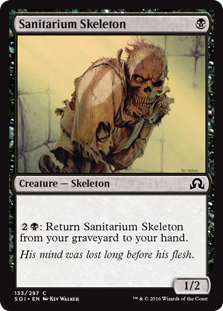

The humble mascot

These rapid-fire observations of contemporary Magic sets represent resistance to the notion that the game design revolves around 1:1 ratios of health potions to health bars and mana potions to mana bars. Food is not just for healing. It can be equally destructive, consuming, and exhausting. It might never even be eaten! The role of food elicits questions such as who produces the food, who receives the food, and who fails to eat? The need for food, for resources remains fundamentally tied to our own mortality in much the same way that absence of any food signals and promises death. As we wait to see what new graveyard and feeding mechanics emerge in Shadow Over Innistrad’s sister set, Eldritch Moon, it is not too early to say that the designers of Magic have joined the leagues of mystics and anthropologists who force us to question just what are we eating to survive?

***
This piece was inspired by Critical Distance's monthly prompt, "Blogs of the Round Table."


Tuesday, September 29, 2015

[Bort Sept. 2015] The Impossible Scaffold


M.C. Escher: Ascending-and-Descending
Maps make no sense. Many people know this, yet we keep making them to organize our sense of space. Jorge Luis Borges’ flash fiction reminds us that the perfect map is useless and instead cartographers must find balance between abstraction and representation to produce maps that can guide us from location to location. A discussion about maps within digital games threatens to fall into the same analogy of a “real” landscape being turned into textual and symbolic representation. This comparison seems flawed since all digital architecture is first and foremost an abstract map-state before ever being realized as a two or three-dimensional terrain filled with visual landmarks. Unlike an explorer who wants sails to uncharted coasts then meticulously sketches what she sees a as video game designer first writes “Here be monsters,” and them the artists and programmers make the dragon appears.
What we might call the “reverse construction” of digital maps means that all digital space has a narrative foundation to its architecture. From the lowliest iPhone app interface to the campaign of the next Call of Duty game, there is always a way the designers want us to navigate the spaces they create. The 2008 game, Gravity Bone, shows us how the subjective experience of narrative can complicate our traditional understanding of maps and literal space. As a short spy-adventure game that requires fewer than fifteen minutes, Blendo Studio’s experimental storytelling stands at the threshold of the post-WASD generation of indie titles. (It can be downloaded here and I recommend a quick playthrough if you want to avoid the spoilers below). Heralded by many as a novel and witty arts game, Gravity Bone plays on the tropes of adventure games only to cut short and kill the player in the second level.
I still remember the surprising gunshot, theft, and broken window that diverted the game’s narrative into a blurred and frantic first-person chase sequence. The jump from the hotel window led me into a neon noir where layers of highways, tramways, and catwalks cling to a concrete canyon while below a glowing and polluted river threatens on the verge of coagulation. The woman jumped down a hole and I followed and flowed effortlessly through chute after chute until we landed upon a table surrounded with masquerading diners. The party goers watched as we unexpected guests dodge and double back through the room only to leave a cloud of shattered champagne flutes in their wake. The door led the woman back into the smoggy darkness where her feet pattered over the metal grating of a dangling catwalk. When I finally caught up to her around the corner she drew her weapon and fired until my body toppled over the railing. My first person view falls slowly like an elevator stopping at each floor to welcome forgotten memories. The flashbacks of past heists and danger inter cut on the screen as I gaze out on the cityscape. Finally, moments before my body lands on the highway, my visions settle on the image of a woman winning a footrace.
The falling death sequence mirrors the first image of the game where the player begins by descending in an elevator. This visual cues point us to an idea of “verticality” which has often been ignored by the game’s commentators. Much of the progress through the earlier portions of the game subsists on descending into the “furnace rooms” where the player find useful items and then emerges back into the hotel sequences to solve minor puzzles. These chthonic spaces promise at some seedy mechanical dystopia that lurks under the cocktail party elegance. Ultimately, the protagonist, Citizen Abel, fails to be a successful spy who can rise and fall between these two spaces and instead falls one last time to his death. What we have in this narrative is an acute awareness of the z-axis, a space that is often ignored for the more popular length and width, “x,y” coordinates, of cartographic space.
Not surprisingly, Gravity Bone is also the kind of action game where maps seem unnecessary. Unlike a sandbox game or RPG, adventure games assume linearity and are often celebrated for elegantly designing a world that guides the player the way a backlot studio tour might lead movie-goers from set piece to set piece of their favorite summer blockbusters. We don’t want a map because we never need to back track or find alternate routes to these locations. Once we experience a specific location we move on forever. In light of this illusion, I propose that action games deserve the most critical cartographic examination. Their mesmerizing, blockbuster pacing too often persuades us to forget the journey and instead revel in the chain of destinations. The notion of “gravity” in Gravity Bone promises this sense of natural acceleration towards the final contact with asphalt but, the moment I take a step back and analyze the passage through space, the illusion collapses.
When I reached the final catwalk and the woman shot me my vertical elevation was actually above the hotel window where the chase began. You can see it in the picture below; it’s the little window in the bottom left. 
This is physically impossible since throughout the entire chase both characters only moved downward. The chutes streamlined the entire chase sequence and forced me to move only one direction. The M.C. Escher lithograph gracing the top of my post provides a visual depiction of Gravity Bone’s vertical chicanery. Known as the penrose stair illusion, this image depicts the physically impossible yet visually conceivable infinite staircase. Gravity Bone’s chase is a virtual realization of the penrose star. What’s curious about this realization is that it did not disorient my experience during my first playthrough. I only noticed the discrepancy in height after several replays-- the narrative actually masks the architectural impossibility of the situation.

Gravity Bone’s narrative arc and ultimate catharsis demanded that the city rearrange itself to let the protagonist fall farther than what ought to be possible. The discrepancy between altitude offers an example of architectural metaphor unique to videogames. What other spatial inconsistencies have I walked right by in video games? What steps do designers take to hide space and distance from our digital eyes? More importantly, how can we add these fantastic virtual leaps to our growing arsenal of hyperlinks and Twine games to build a more powerful nexus for self-expression and storytelling? I suspect Borges and Escher still have much more to tell us about the rules and rule-breaking potentials of those atlases that arrange our world.  

Tuesday, June 4, 2013

Wes Craven Double Review

Last semester, I went to a midnight screening of Wes Craven's Scream (1996). I then went to a talk with Wes Craven hosted by my school. Finally, last night I watched A Nightmare on Elmstreet. This double review will therefore include ideas from that talk and my thoughts on Wes Craven in general.

The first thing to know about Wes Craven is he did not plan on a film career. He read profusely as a child, a act that allowed him to escape the narrow thought of his Fundamentalist Baptist upbringing (an upbringing that forbid movies!). Made  his way to college and continued to read and study literature. He got a job teaching history of Western Civilization at some small college in the North East. Western Civilization, that's the key. I notice that Wes Craven's horror includes an understanding of the most elemental components of Western narrative. A Nightmare on Elmestreet, as he explained, deals with the fundamental human experience of dreams. If your English class ever read Macbeth, your mind should be buzzing with the half memories of lectures about Macbeth upsetting the natural sanctity of sleep when he kills Duncan. Its no accident that during Nancy's nightmare at school, the teacher is also teaching Shakespeare. Wes Craven bursts with Western Canon.

In the talk, Craven mentioned his fascination with nightmares. What is the evolutionary purpose of the nightmare. He answer: we need the mental stage to cope with our fear. A place to explore our fears of death and our concern about evil that lurks at the fringes of rationality. Stories of evil are necessary in our society.

This brings us the evil core of Nightmare, Freddy Kruger. His creation in an amalgam of several ideas. His method of attack, through dreams, came from an article on a Cambodian child afraid of sleeping because of his war-torn nightmares. The dream is a space where we have no protection, no one can help us. He implement: a glove of knives, combines the primordial weapon of the knife with the dextrous hand. His costume: a sweater whose two colors cause the most amount of retinal stress. No need to hide in the shadows in a dream. With his ability to teleport, Freddy can be equally garish and nightmarish. The most important component though is that ultimately evil intention of wanting to hurt children. Wes Craven told us about his terror as a child looking out his window seeing a man, presumably drunk, staring back at him from the street. Young Wes pulled back from view, hid in his room. After an indescribable amount of time, he returned to the window, the man was still there. That is a man who wanted to terrorize an innocent child. That is evil.

Returning to the Craven's narrative structure. I've noticed the theme of sins. Sins of the parents in Last House on the Left to avenge the sins against their child. Sins of the parents being paid by the child for Nightmare. The parents killed a man, and that man will in turn kill their own children. Scream also has a similar narrative seed. The killer, Billy, wanted to make Sidney Prescott's mother pay for sleeping with his dad. That's my favorite part about Scream, cut through all the jokes, meta jokes, and meta-meta-jokes (nothing beats bugging the TV room with a camera and putting the couch of horror viewing onto the screen to then be watched by the audience) and there is still a damn good mystery and damn good characters.

Wes Craven's characters rock. Most horror, even some of my favorites, does not flesh out any characters, some will only invest in the protagonist. Craven makes everyone interesting. The mother of Nightmare has an amazing amount of suffering and problems that are tangent to the main story about her daughter but such character development is relevant to increasing the stakes by showing that these are all real people being terrorized by the supernatural.

Returning to the power of this terror, I love the frustration integral to horror. This frustration is more than just screaming at the idiots on the screen, "don't go in there!". The best employment of such frustration evokes a dread at our own helplessness. That moment when our muscles tense, "Oh shit", and yet we can't do anything. Fight or flight fails. We are biologically helpless, yet the evil is still going to get us. Nightmare is full of such dreaded helpless moments: bars on Nancy's house locking her inside with a killer ghoul, the boyfriend falling asleep... twice, and seeing the sheets tie themselves in a noose while the police doubt Nancy's warnings. The greatest emerges from the very nature of dreams. The lack of an explanation about the beginning of a dream, so beautifully described by DiCaprio in the link, is a genius way to begin a horror sequence. When I heard Nancy's phone ring after she unplugged it... goose bumps, heart rate, trembling shaking anxiety. Shit, we're already in a dream. Shit, shit, shit. He's going to get us.

That is horror.


I conclude with a beautiful quote from the Wes Craven talk. This should be every horror fans response to those who pompously say there is no reason to pay to be scared.


"We don't pay to be scared. We are already afraid before we go to the theater."

Friday, December 28, 2012

Rabid (1977)

keloid /ke·loid/ (ke´loid)
a sharply elevated, irregularly shaped, progressively enlarging scar due to excessive collagen formation in the dermis during connective tissue repair.

Following up my essay on the architecture of Cronenberg's Shivers, it's fitting I continue with his second film of body horror, Rabid. I enjoyed recognizing some stars from Shivers returning to the screen. In fact, Shivers and Rabid create a pleasant multiverse alternative timeline ot the fall of Montreal by zombie-like transformed humans. And yet Cronenberg does not trap himself within the confines of the zombie genre. My few comments on Rabid will consider the physiological message emerging from Keloid Clinic.

As a plastic surgery clinic, they seek to make external appearance beautiful. The examination room has a poster of da Vinci's Vitruvian Man on the wall. The use of these "neutral cells" (read as stem cells) to recreate the proper texture of flesh show. I caught a phrase from a magazine in the waiting lounge, "the truth about skin care" that seems to be a late warning about this fixation on the external. Ironically, a keloid does form and these aesteticians cause internal changes they cannot begin to comprehend.

The motif of external to internal leads to support the perhaps obvious conclusion that Rabid is a film of penetration. The protagonist's armpit penis, the use of needles to immunize, feed, and sedate, the drill that penetrates the health minister's car, and most importantly, biting, the vector for infection. The doctors of the clinic gave a female a phallus, perhaps they only imagine true beauty in the shape of a man?

I Spit On Your Grave (1978)

Why do I suffer the exploitation film? They are horrible. Where chain saws and gore transgress the physical boundaries of our contemporary culture, watching rape shatters the mental boundaries of human imagination. I Spit On Your Grave seeks to show the totality of masculine brutality against women.

The color red is a pervasive hue in the film that works at multiple levels to address the problem of violence against women. Red is the reason, the warning signal, the stage of, and the after glow of the violence. The multitude of meaning in this single signifier presents the argument that misogyny is ubiquitous in our society. Jen's solution of murder implies stopping misogyny requires revenge that is equally beyond societal boundaries.

The color manifests as lipstick, a red dress, nail polish, and the apple that Jen gives Matthew. These reds are seductive, they seem to support Johnny's pathetic excuse that Jen "asked for it" through provocative actions.

The red of the gas station stands, the summer cabin's decorations, lampshade, curtains, kitchen wall, and the interior of her river canoe are a foreshadowing of the kidnapping and rape.

The final brutal onslaught in her cabin, marked by the terrifying scare of the boot kicking the phone from her hand, is saturate with red. The crimson carpet, the red armchair, her bloodied frame all painting the image of carnage against women.

Finally, three of the four murders involve blood diffusing into water. Cloudy red water of the attackers is the chromatic reversal of Jen's experience. She escapes on her motorboat leaving evidence of the violence to seep into the river and disperse until it disappears to hide her deeds. Red, at the end of the film, becomes evidence of successful revenge and victory of the men.

The visual presence of red works to eroticize the protagonist, to warn her of the attack but also becomes an element of the violence and a marker of her revenge; these contrasting instances complicate our understanding of its use. By being associated with the entire plot of the film, red gains universal presence. Instead of symbolizing a single emotion, it represents the entire societal culture of violence against women. With this reading, red becomes the backdrop of the events, a stage that permits the cycle of misogyny to continue as a whole even if Jen killed her specific attackers.

This film.

It's crude. It's amateur. It ends with the creation of a female killer who's origins are fundamentally different from the mindless masculine evil of Mike Myers and Leatherface. The woman has reasons, her evil only emerges from revenge, it was never intrinsic.

Sunday, December 16, 2012

The Last House on the Left (1972)

This film made me sick. I know that my last post praised the masterpiece horror in The Texas Chain Saw Massacre due to the film's mastery of sensory emotions. But I must immediately raise another rapturous celebration for Last House's achievements in exploitation horror. Where Tobe Hooper succeeded by manipulating the objective correlative, I will claim that Wes Craven's success derives from his mastery of structure. Last House frames itself as a Shakespearean tragedy and revenge tale placed in the backwater town road outside a city (it may be New York, but the effect of the film does not require an specific location). I say Shakespearean because of the comic relief scenes involving the police officers. Just as the Gatekeeper in Macbeth disrupts the aftermath of the murder to inject a comic soliloquy, these police men brilliantly pull the audience out of the pit of overwhelming pathos. Another Shakespearean element is the gripping frustration at how close the tragedy came to being avoided. Just as Shakespeare denies Juliet seeing Romeo before he takes his life, Craven brutally denies Mari and Phyllis salvation from their captors even though both the police and Mari's home are tantalizingly close during the entire ordeal of bloodthirsty abuse, torture, and murder.

I repeat, this film made me sick.

Thursday, November 22, 2012

The Texas Chain Saw Massacre (1974)

I must admit my project in horror literacy is outlandish and juvenile in many eyes. Sturgeon's law is no exception to my genre of interest, 90% is absolute crap, and I embrace such a reality. However, such a law does not mean to diminish the value of that 10% that strives to join the pantheon of arts. Tobe Hooper's The Texas Chain Saw Massacre, 1974, is a member of the 10% that succeeds in art's eternal struggle to evoke emotion.

I interpret Hooper's success to the employment of the objective correlative, a modernist term to describe art's effect. Championed by T.S. Eliot, this theory of art argues:

"The only way of expressing emotion in the form of art is by finding an “objective correlative”; in other words, a set of objects, a situation, a chain of events which shall be the formula of that particular emotion; such that when the external facts, which must terminate in sensory experience, are given, the emotion is immediately evoked"

--http://www.britannica.com/EBchecked/topic/423797/objective-correlative

Unlike the above definition, The Texas Chain Saw Massacre as an singular film presents its simple "external fact" at the beginning of the experience, namely that it was a real, historic event. The subsequent mundane dialogue and rural American setting that introduce the doomed protagonists further re-enforce the singular "external fact". This (ir)rational grain of knowledge looms at the back of the consciousness a germinates to a dread that "this could actually happen" within the bowels of the American heartland. Within this structure, the objective correlative horror of individual scenes act by juxtaposition of objects and human senses that become unified by the terminating "external fact" which leads to a dread about our frailty against the madness of cannibalism.  
  
After corrupting the mental domain of the audience member's mind, the film begins a merciless assault upon sensory organs. Once the date fades from the screen, pure audio clips of scratching shovels and shifting earth begin the tale. Suddenly a flash of light burns the retina with the image of a decaying hand. Visual disgust initiates as the mottled, shrunken fingers shock the audience with the simple image of decay. The flashes, the decaying masses, and the whining of the bulb's capacitors all act to create an unnatural experience of rot but deny the audience a complete image. The sudden change to an orange hued image of a skinless corpse is the final shocking, unexplained scene of the introduction. The rotting skin glistens in the sunlight  signalling, if not a specific smell, the realization that this corpse is an abomination of the olfactory. This introductory sequence finishes its own objective correlative micro-arc with the radio's announcement: "Grave-robbing in Texas is this hour's top news story". At this moment, the audience understands that the camera flashes were the dreadfully unnatural transgression of the living against the dead. 

A second, powerful employment of the objective correlative occurs when Pam follows her boyfriend into the house and stumbles into a parlor with more bones than an ossuary and a single, caged chicken. The dark, ruined homestead is already a site of terror and unknown, but this single room sets up the film's central conflict of cannibalism. Feathers, bits of fur, and bone fragments coat the floor and offer a tactile sensation of filth as Pam falls onto the dirty floor. The single, freightened chicken provides an organic clucking that layers over the horror soundtrack and adds links the defiled room to the American image of the farm. The camera pans over the detritus on the floorboards and finds the bones of a human leg. It follows the familiar forms of leg and arm, creating the expectation of a sitting skeleton. Instead, the surprise is another piece of art, a couch outlined with the human skeleton. The continued panning over cracked turtle shells and swinging parts again offers the tactile sensation of their delicate fragility. Pam's wretching summons the viewer's imagination to construct the physical cringing of the internal organs. The sudden action sequence of Leatherface capturing Pam and carrying her into the "kitchen" climaxes to the most powerful physical sensation in the entire film. The meat hook. I will argue that proprioception, the sense of one's own place in space, is a more primal sense than the traditional five external senses. The ability to "feel" where our limbs exist allows to place ourselves into three-dimensional space. As a result, although we will never be held up off the ground by a meat hook piercing our back, every audience member can sense the pull of their body mass against the hook. Horrified by our own minds creating the self-perception of being hooked, the scene completes its absolute sensory overload. As a last treat, the objective correlative again offers up the "external fact" that this is the home of cannibals, and that the protagonists will be chopped up and eaten. 

The final objective correlative I present is Sally Hardesty's interaction with Grandpa. At this point the audience has been living in an adrenaline typhoon as Sally escaped Leatherface only to be captured and returned by the proprietor of the gas station. The blinding glare of the unshaded lamps casts shadows throughout the dining hall. Gagged and tied, the film's use of proprioception allows the tense audience to "feel" the constraints. After bringing Grandpa, the chair-bound human husk, to the table, the hitchhiker and Leatherface slice Sally's finger (one of the few, explicit moments of blood). The final objective correlative moment in this scene happens simultaneously with the revelation of the "external fact" that catapults the audience into the finest level of dread and disgust; Grandpa begins to suck. At this moment, the audience realizes that the mummified body is still alive. Defying age, the man sucks at the finger like a child sucks the nipple. Vile on basest, Freudian level, the audience can feel the sensation of having their finger sucked. Comprehension of this infantile sensation coupled with disturbing visual of an old man slurping and squirming like a new born throws one "over the cliff". It's the gross-out moment of the film, the horror that simultaneously becomes unbelievable, terrifying, and comic. The horrality

This analysis of the objective correlative is my evidence for The Texas Chain Saw Massacre's classification as a masterpiece. The film applies the modernist definition of emotion evoking art by creating scenes that employ all the senses of the spectator. Through sensory overload, the film gains control over the audience and concentrates their emotions to a single feeling of dread for being at the pointy end of society's cannibalism taboo. This dread is not inferior to the emotions created by other art. Just because it may be more uncomfortable than a Beethoven symphony or D.W. Griffith epic  does not justify a label of inferiority. The Texas Chain Saw Massacre is an overwhelming cinematic force and deserves respect for its ability to make civilized man fear.

Misc. Thoughts

My side thoughts that would not fit within the above essay.
 
The demonic red chiascuro of the title sequence is beautiful. If this visual aesthetic interests you, consider the contemporary abstract art/horror film Begotten.

 I want to point out the reference to Psycho by using the motiff of family members maintaining the corpses of their elders, in this case "Grandma" and "the dog".

There are essays that consider the parody of the family American dinner table while Sally is tied up. I thought that the attempt to have Grandpa kill Sally is similar to Patrick Star's attempt to get Squidward to hold the jelly-fishing net. Absurd comedy for the win!
"firmly grasp it!"

Finally, the gritty art style,  obvious chain saw-wielding antagonists,  "horror soundtrack", backwater decaying buildings, and use of cannibalistic implications all make me conclude that Resident Evil 4's art direction borrowed greatly from aesthetics of this film.